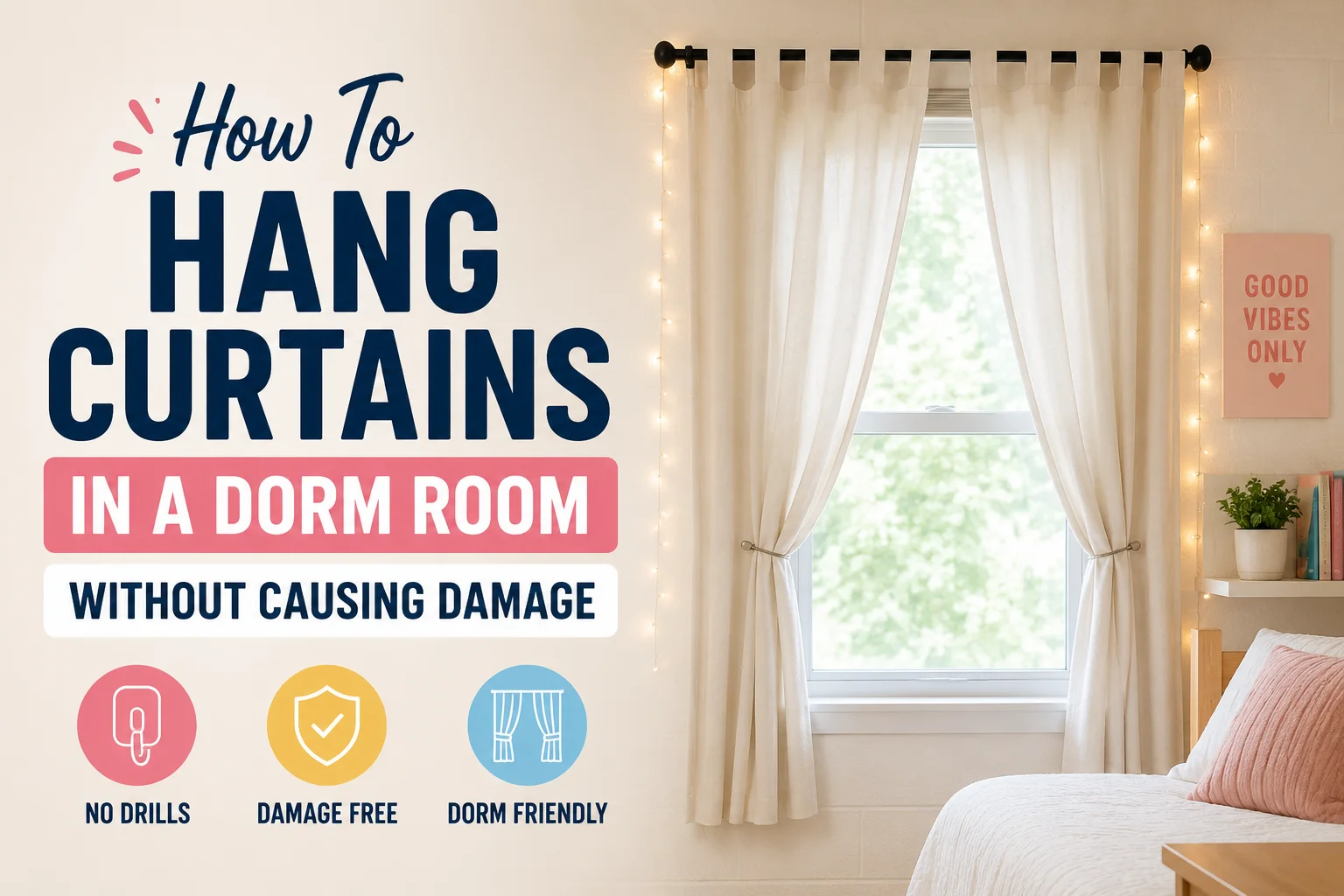
Curtains can make a basic dorm room feel warmer, more private, and more like your own space. The challenge is installing them when your college does not allow nails, screws, drilling, or permanent changes.
Fortunately, there are several dorm-friendly ways to hang curtains without damaging the walls or window trim. The right choice depends on your window shape, curtain weight, and college housing rules.
Affiliate disclosure: This article contains affiliate links. HowItSee may earn a small commission from qualifying purchases at no additional cost to you.
Besides improving the look of your room, curtains can soften harsh daylight, reduce screen glare, add privacy, and help an unfamiliar space feel more comfortable.
Before installing anything, read your college housing policy carefully. Some dorms prohibit specific adhesives, pressure-mounted rods, attachments to window trim, or floor-to-ceiling structures.
Quick recommendation: A properly fitted tension rod is usually the simplest fully removable option. If the window cannot hold one, lightweight curtains supported by approved adhesive hooks are often the next easiest choice.
Dorm Curtain Hanging Methods Compared
| Method | Best Use | Damage-Free? | Amazon Link |
|---|---|---|---|
| Command Curtain Rod Hooks | Lightweight or sheer curtains | Usually, when installed and removed correctly | View on Amazon |
| Adhesive Curtain Rod Brackets | A neat peel-and-stick installation | Usually, depending on the surface | View on Amazon |
| Tension Curtain Rod | Windows with an inside frame | Yes, when properly fitted | View on Amazon |
| Twist And Fit Curtain Rod | A sturdier pressure-mounted setup | Yes for many compatible windows | View on Amazon |
| Floor-To-Ceiling Curtain Stand | Room dividers, privacy panels, or wide spaces | Yes, when permitted and correctly installed | View on Amazon |
How To Hang Dorm Room Curtains Without Damage
1. Use Command Curtain Rod Hooks
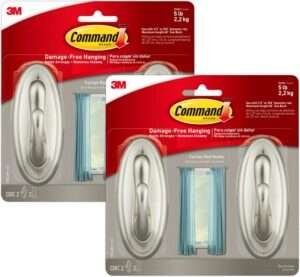
Command curtain rod hooks are a convenient choice when drilling and nails are not allowed. The hooks attach with removable adhesive strips and create supports for a lightweight curtain rod.
This approach works best with sheer or light-filtering panels. Heavy curtains may exceed the hook or adhesive weight limit and pull away from the surface.
How to install the hooks:
- Confirm that your housing policy allows removable adhesive strips.
- Measure and mark the position of both hooks so the rod will hang level.
- Clean the approved surface with rubbing alcohol and allow it to dry.
- Apply each adhesive strip and press the hook firmly into place.
- Wait for the full curing period stated by the manufacturer before adding weight.
- Install the slim rod and lightweight curtain panels, then check that both hooks remain secure.
Do not rush the waiting period. Adhesive that has not fully bonded is more likely to loosen once the rod and curtains are added.
2. Try Universal Adhesive Curtain Rod Brackets
Adhesive curtain rod brackets are designed specifically to cradle a curtain rod. They can create a cleaner appearance than general-purpose wall hooks while still avoiding screws and drilling.
The quality of the hold depends on the bracket design, curtain weight, wall finish, and how carefully the surface is prepared.
How to use adhesive brackets:
- Measure the window and mark the bracket positions carefully.
- Make sure both marks are level before applying adhesive.
- Clean and dry the surface as directed by the product instructions.
- Remove the backing and press each bracket firmly into position.
- Allow the adhesive to cure before installing the curtain rod.
- Begin with lightweight curtains and monitor the brackets for movement.

3. Use A Tension Curtain Rod
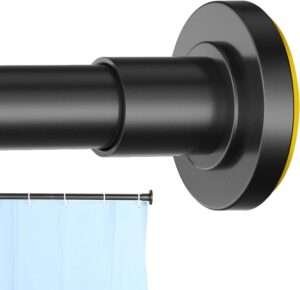
A tension rod is often the best option for hanging dorm curtains without leaving residue, holes, or marks. It stays in place through outward pressure against two opposite sides of the window opening.
This method only works when the window has a suitable recessed frame with two flat, sturdy surfaces for the rod ends.
How to install a tension rod:
- Measure the exact inside width of the window opening.
- Choose a tension rod whose adjustable range includes that measurement.
- Slide the curtain panels or rings onto the rod.
- Position the rod between the two sides of the window frame.
- Twist or extend it until it feels firm without placing excessive pressure on the trim.
- Test the rod gently before leaving the curtains in place.
A basic tension rod is not usually intended for thick, heavy curtains. Choose a stronger system when the curtain fabric has significant weight.
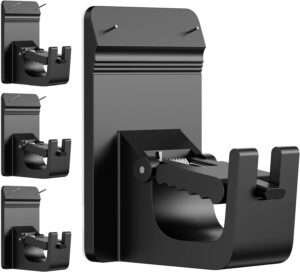
4. Use No-Drill Curtain Rod Brackets
No-drill curtain brackets are made to fit around or onto window trim without traditional screws. Depending on the model, they may clamp in place, tap onto the trim, or rely on very small pins.
They can support more weight than some adhesive products, but the phrase “no-drill” does not always mean completely mark-free.
When this option makes sense:
Consider this method when the dorm has suitable wooden trim and you need a system that feels sturdier than adhesive hooks or a light tension rod.
5. Use A Twist And Fit Curtain Rod
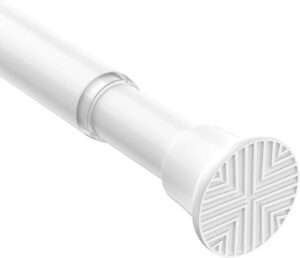
A twist-and-fit rod uses pressure in a way similar to a traditional tension rod, but many designs include broader end supports or bracket-like pieces for additional stability.
It can be a useful middle ground when you want a polished no-drill appearance but do not want to depend on adhesive strips.
Measure carefully before purchasing. The rod must match the usable width of the window or wall opening to create safe, reliable pressure.
6. Use A Floor-To-Ceiling Curtain Stand
A floor-to-ceiling curtain stand avoids the wall and window trim entirely. Vertical poles extend between the floor and ceiling, while a horizontal support holds the curtain panels.
This type of system can cover an awkward window, create privacy around a bed, or divide a shared room without installing permanent hardware.
A curtain stand takes up more physical space than a small rod, so measure the room carefully. Confirm that the ceiling type and housing rules are compatible before installation.

What Size Curtains Work In A Dorm Room?
There is no universal dorm window size. Windows can differ between colleges, residence halls, floors, and even rooms in the same building. Measure the actual window whenever possible instead of relying only on a general dorm packing list.
Common ready-made choices include curtains around 42 inches wide by 63 inches long, 52 by 63 inches, and 52 by 84 inches. These are only starting points—the correct size depends on your window width, rod position, and preferred curtain length.
Simple Dorm Curtain Measuring Guide
- Measure the window width and the available mounting area.
- Choose panels with a combined width greater than the window so they do not look flat when closed.
- Measure from the planned rod position to the point where you want the curtains to end.
- For a full-length look, allow the panels to touch or lightly skim the floor without bunching.
- Use shorter curtains when furniture, a desk, radiator, or air unit sits directly below the window.
- Check whether your chosen rod sits inside the frame or above it, since this changes the required length.
Which Curtains Are Best For A Dorm?
The safest curtain choice depends on the amount of privacy and light control you need, as well as the strength of your hanging method. Lightweight, washable panels are generally the easiest to install and maintain.
| Curtain Type | Best For | What To Consider |
|---|---|---|
| Sheer Curtains | Softening the room while keeping natural light | They are lightweight but provide limited privacy, especially after dark. |
| Light-Filtering Curtains | General dorm use and moderate privacy | They offer a practical balance of weight, brightness, and coverage. |
| Blackout Curtains | Reducing sunlight and improving sleep | They are often heavier and may require a stronger rod or bracket system. |
The Safest Place To Start
Use a tension rod when your window has a compatible recessed frame. When it does not, approved removable curtain hooks paired with lightweight panels can provide a simple alternative. Always follow the product weight limit and your college housing rules.
More Dorm Room Guides
Continue preparing your room with these related HowItSee guides:
FAQs About Hanging Curtains In A Dorm Room
Can you hang curtains in a college dorm?
Many colleges allow curtains when students use an approved temporary method. Tension rods, removable adhesive hooks, adhesive brackets, and freestanding curtain systems are common possibilities, but the housing policy should always be checked first.
Can Command hooks hold dorm curtains?
Curtain-specific Command hooks can support a slim rod and lightweight panels when the wall surface is compatible and the instructions are followed. Clean the surface, respect the curing time, and stay below the stated weight limit.
What is the most damage-free way to hang dorm curtains?
A correctly sized tension rod is usually the most straightforward option because it does not use glue, nails, screws, or pins. It is only suitable when the window frame provides two stable surfaces for pressure.
Can blackout curtains be used in a dorm room?
Yes, but blackout panels are generally heavier than sheer and light-filtering curtains. Use a rod or bracket system rated for their combined weight, and confirm that the installation method is permitted by the college.
Will adhesive hooks damage dorm walls?
They are designed for clean removal from compatible surfaces, but damage is still possible if the paint is weak, the wall is textured, the strip is overloaded, or the hook is removed incorrectly. Follow the removal directions and ask housing staff when unsure.
Final Thoughts
Hanging curtains in a dorm room is mostly about matching the installation method to the window and curtain weight. A lightweight panel may work perfectly with removable hooks, while a recessed frame may make a tension rod the easiest solution.
Students who need more privacy or want to divide a shared room can consider a floor-to-ceiling curtain stand, provided the room dimensions and housing policy allow it.
Measure before ordering, avoid exceeding weight limits, and never assume that “no-drill” automatically means approved or completely mark-free. With the right setup, curtains can make a small dorm room feel softer, calmer, and more personal without creating move-out problems.

Meet Monty, the visionary founder of How It See, being an engineering student, he’s fueled by an insatiable curiosity about the world around him. He is captivated by an eclectic correlation between animal groups, science, and nature, and this fascination drives his quest for understanding.
After completing his degree, he’s set on a mission to delve deep into the realm of nature, accumulating knowledge to share with you through his writing. In the meantime, he loves to watch anime and read anime.