Horses are from the taxonomic family, Equidae which has transformed over the past 45 to 55 million years. Presently, everyone in their life has already heard about the name of this animal at least once in a lifetime. But have you wondered, can horses see in color? If yes, how?
So, the answer to the question, “What colors can horses see,” is: Horses can see different color shades ranging from 428 nm (blue) to 539 nm (yellow) at best. They can easily see color variation from blue, green and yellow but cannot differentiate orange-red colors.
Horses are dichromatic and have a two-color vision, i.e., blue-green. They have Equine color vision and can see the world mostly in dull-blue, yellow and gray colors.
In terms of color differentiation, the human eye is much better than the horse eye; however, horses have the upper hand when it comes to dark. Later in this post, we have discussed more on horse vision and how they see the world.
What colors can Horses see?
Horses can see mostly yellow, dull-blue, and gray color shades. They are dichromats and can differentiate colors in short-ranged and middle-ranged wavelength regions.
It means the cones and rods in their eyes are sensitive only to the blue-green color of the spectrum and the color variations based upon them.
Horses can see colors from 428 nm to 539 nm
In contrast, humans have trichromatic vision and can perceive blue, green, and red colors from wavelength 380 to 720 nm. In this way, we are able to distinguish millions of color shades.
Now back to the horses’ eyesight. It is estimated that horses are able to distinguish colors by 539 nm. After that wavelength, they witness everything in gray shades.
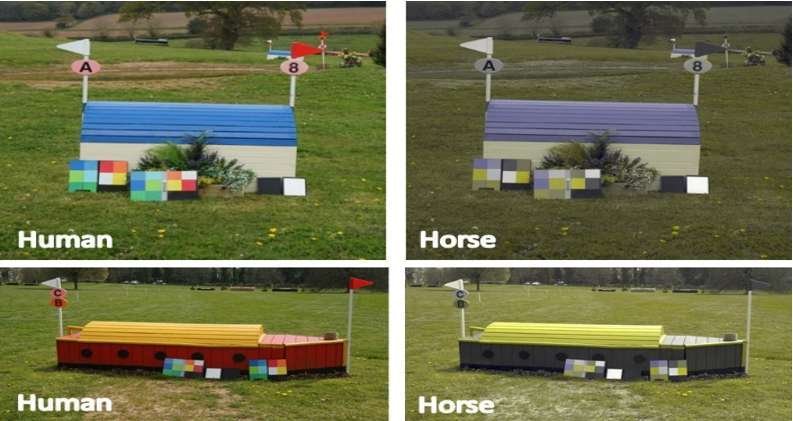
According to the research, horses are able to pinpoint blue, yellow, and green from gray but face difficulty in differentiating red from green or orange. They see all the red shades in gray color.
In a nutshell, they have a similar vision to humans who have red-green colorblindness. Below, we have attached an image to demonstrate horse color vision.
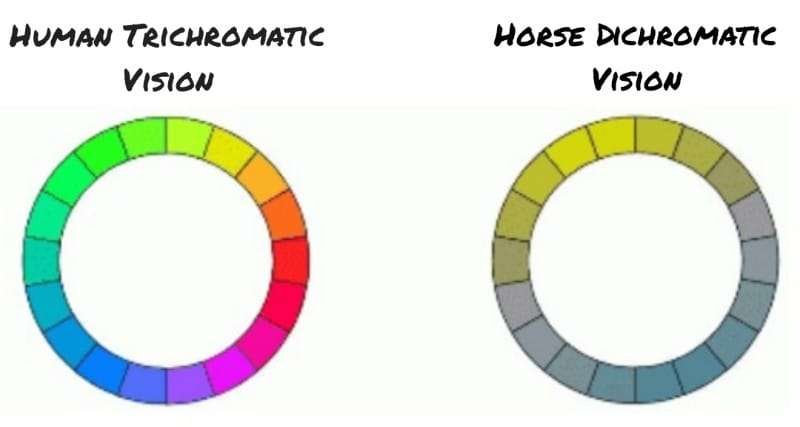
Through this image, you can understand what colors horses see. They are not completely color blind. But due to being dichromatic, their cones cannot individualize the long-wavelength color like red. They do not have large wavelength cones in their eyes.
Also, during dawn or dusk, horses are most active because the environment comprises the majority with the short-wavelength colors at that time, like blue and violet. It grants them the ability to discover the predators in the wild.
Most predators are active during the night or at the time of dawn or dusk, and horses have evolved their eyes to identify them easily with the help of rods. Rods in the eyes helps to distinguish the world in low-light condition, whereas cones in the eyes assist in recognizing millions of color shades.
Horses do not need color vision; therefore, they have evolved vision which is better in low-light conditions for survival in exchange for color vision.
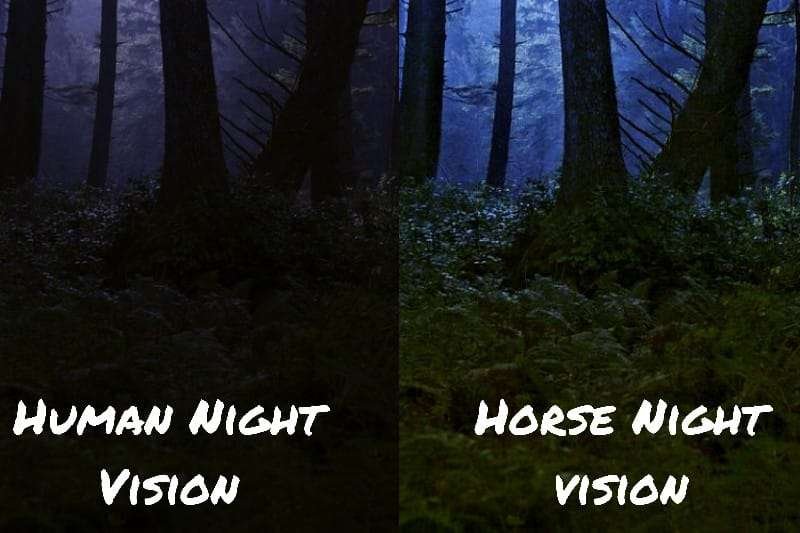
Unlike humans, they see much better in the dark or in low-light conditions. Below we have discussed more on horses’ night vision and how they are able to see much better in the dark compared to humans.
Can Horses see in the Dark?
Yes, horses can see much better in the dark or at night as compared to humans. They have a layer of tapetum lucidum in their eyes, allowing them to reflect the slightest light back onto the retina for greater absorption.
It signifies horses can see at night. Every nocturnal animal has tapetum lucidum allows them to wander at night.