A snake is a magnificent creature with interesting habits, ecology, and color patterns. There are some beautiful snakes found in nature with eye-catching colors and patterns. Today, we’ll be talking about yellow and brown snakesand how they are so magnificent.
Yellow and brown snakes are found abundantly in nature. This is because muted yellow and brown resemble the color of sand and mud, as well as bushes and leaves.
It helps the snakes better camouflage themselves in nature to hide from predators or employ surprise attacks on their prey. Some of the snakes listed below are venomous, but some are not harmful to humans.
With this, let’s see what our magnificent yellow and brown snakes look like.
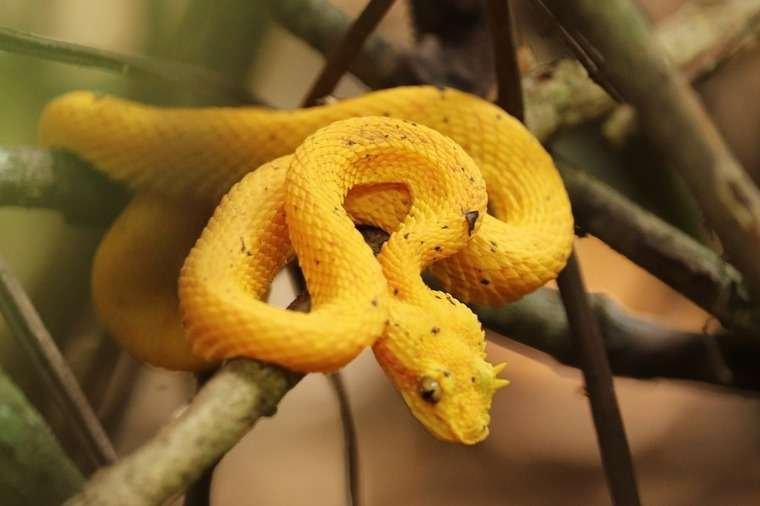
Eyelash Viper, like all vipers, is a venomous snake species. The species gets its name from the modified superciliary scales above its eyes that look like eyelashes. These eyelashes help the snake in camouflage, helping its outline to break up among the foliage it hides.
Eyelash Viper is a moderately long snake with characteristic eyelashes and needle-like fangs. Its colors come in a wide range, including red, pink, and green. A very common skin color of them is bright yellow with occasional brown dots all over the body.
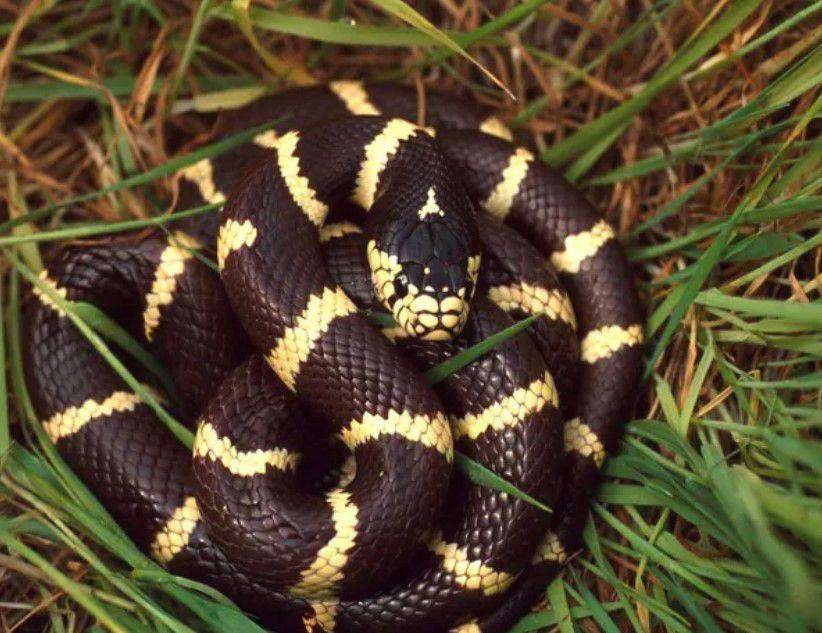
Desert Kingsnake is a nonvenomous snake species living in well-moisturized environments despite its name. It dominates its prey by constriction. A special trait of this snake is its immunity from pit viper venom.
Desert Kingsnake is a long and thick snake that uses its size to its advantage. The snake is primarily yellow-skinned with broad dark brown spots on its back. The spots disperse and become less prominent towards the ventral side.
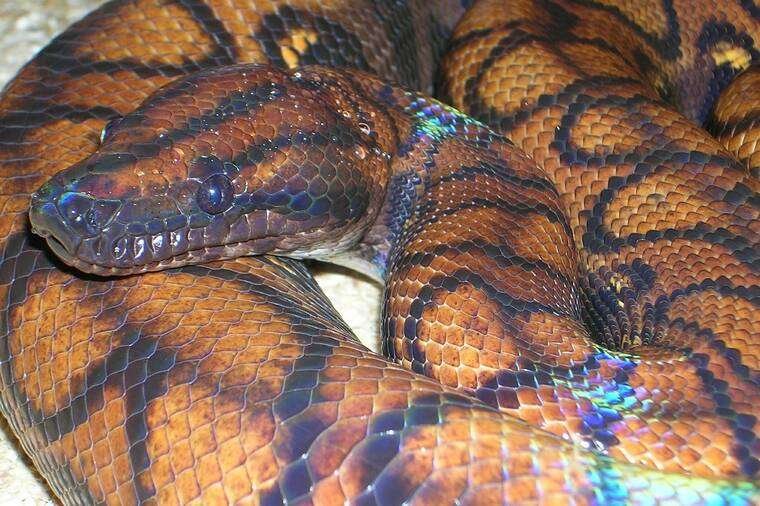
The third entry on the magnificent yellow and brown snakes list is the Rainbow Snake. It is a species of nonvenomous aquatic snake. True to its name, the rainbow snake is a beautiful snake with an enchanting color scheme.
Its whole body is patterned with multiple stripes of different colors. The colors consist of red, navy blue, orange, and yellow. The scales of this snake are shimmering, which causes it to shine in the presence of light. A truly gorgeous creature.
Common Name: Eel Moccasin, Horn Snake, Red-Lined Snake, Red-Lined Horned Snake, Red-Sided Snake, Sandhog, Sand Snake, Striped Wampum
Significant Name: Farancia erytrogramma
Size: 91 – 122 centimeters (36 – 48 inches)
Location: Southeastern United States
4) Malabar Pit Viper
Malabar Pit Viper is a member of the Viper family and is venomous. This snake species is endemic to India, though it is not in danger of extinction. Its venom is fairly mild and causes slight pain and swelling, and subsides after 2-3 days.
Malabar pit viper appears in different color schemes, including green, brown, and ash-white. One of them is yellow with brown patterns on it.
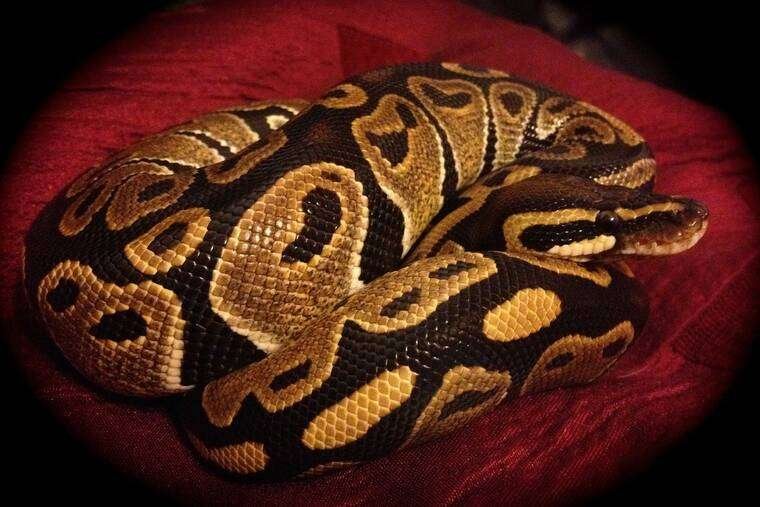
Ball Python, like every other python, is nonvenomous and attacks its prey by constriction. Its name is a reference to its habit of curling into a ball when threatened or stressed.
This python species has to suffer from poaching for the international exotic pet trade. This causes a loss of the number of these snakes in their natural habitat. Because of this, IUCN has listed the ball python as Near Threatened in their Red List of Threatened Species.
The ball python is a very large snake with black, yellow, and brown colors. It has black as the background color with yellow patterns all over the body and occasional brown splotches. The yellow patterns sometimes have black or brown dots on them.
We have another big snake on this yellow and brown snake list. Jamaican Boa, as its very name suggests, is a boa species endemic to Jamaica, including Goat Island. Like other boas, it is also not venomous.
Due to this snake’s steady population decline, IUCN has added it to the Red List of Threatened Species as a Vulnerable species. It is also listed as a Protected species under the Wild Life Protection Act of 1945 and Appendix I of CITES.
Jamaican Boa has a skin color of bright yellow. The yellow has dark brown patterns all over it, in some places, concentrated, and in some places, lighter. The head of the snake is a pale yellow-green color.
Common Name: Yellow Snake
Significant Name: Chilabothrus subflavus
Size: 6 feet 7 inches
Location: Jamaica
7) Indian Rat Snake
Indian Rat Snake, despite its name, is not endemic to India. In fact, this nonvenomous species can be found in many countries in south and southeast Asia. This species is totally harmless to humans and has no major predators except for the King Cobra, which preys upon the younger rat snakes.
The Indian rat snake is a fairly long snake but is narrow in diameter. It has yellow skin that is paler on the belly side, with thin dark brown marks along the body. The snake also has brown-bordered eyes with round pupils.
Common Name: Oriental Rat Snake
Significant Name: Ptyas mucosa
Size: 4 feet 11 inches – 6 feet 5 inches
Location: Afghanistan, Bangladesh, Cambodia, China, India, Indonesia, Iran, Laos, Myanmar, Nepal, Pakistan, Sri Lanka, Taiwan, Thailand, Turkmenistan, Vietnam, West Malaysia
8) Military Ground Snake
The Military Ground Snake is native to the South American continent. The snakes of this species are nonvenomous.
Not much is known about this species, but it is known to show parasitism. It carries two parasites, namely Ophidiascaris sp. and Oligatanthorynchus spira, in its stomach and peritoneum, respectively.
Military ground snake is small in size. Its body is dark brown on the dorsal side and patterned with small yellow dots all over, up to its head. The ventral side, on the other hand, is completely yellow.
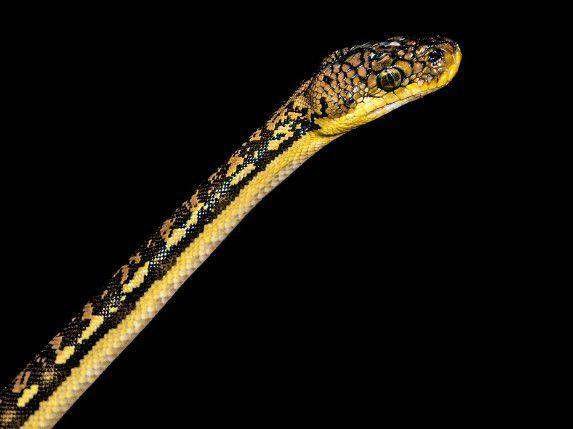
Timor Python is another python that found its spot on our list of magnificent yellow and blue snakes. It is nonvenomous and constricts its prey to subdue them.
It is not considered dangerous for humans and is sometimes kept as pets. While the Timor python is a cold-blooded animal, it has heat-sensing pits on its head to sense hot-blooded prey in total darkness.
Timor python is not the biggest of boas, but its size is considerable nonetheless. It has a yellow dorsal side with dark brown markings and a ventral side white with yellow at the edges. This snake also has gray-green eyes with vertical slit pupils.
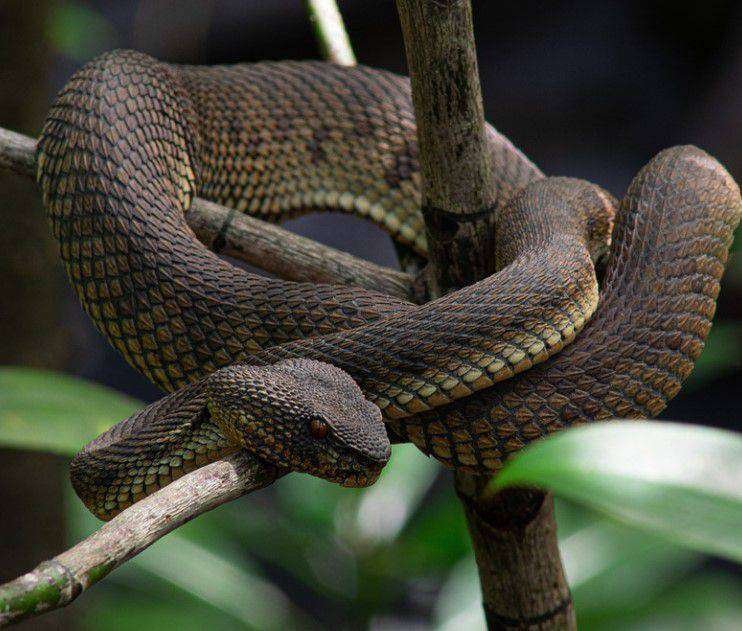
Mangrove Pit Vipers, or we can say Shore Pit Vipers are highly venomous snakes from pit viper species. These snakes have variable body colors. And here, we are taking the one having the dusty brown dorsal with the light yellow lower body, as shown in the image.
Like many other pit vipers, the venom of these snakes is highly potent and can lead to many fatal problems like nausea and vomiting. Females are generally larger than males. Mangrove Pit Vipers mainly feed on lizards, frogs, and other small animals, sometimes small birds.
Common Name: mangrove viper, shore pit viper
Significant Name: Trimeresurus purpureomaculatus
Size: 20-35 inches
Location: Bangladesh, Burma, Thailand, West Malaysia, Singapore and Indonesia
11) Green tree Python
The juvenile stages of the green tree python are yellow in color with brown speckles that turn green when they grow into adults.
Females tend to be larger and heavier than males. One can find these pythons in Australia, Indonesia, and Papua New Guinea, inhabiting tropical rainforests, monsoon forests, thickets of bamboo, and forest margins with bushes and shrubs.
Oviparous, can lay up to 6 to 25 eggs per clutch.
Common Name: Green Tree Python
Significant Name: Morelia viridis
Size: 150-200 cm (4.9-6.6 ft)
Location: Australia, Indonesia, Papua New Guinea
12) Speckled kingsnake
This non-venomous snake, the Speckled King Snake, is commonly found in Mexico and the United States, from Texas to Nebraska. They are blackish brown in color with small white or yellow specks.
These nocturnals have an opportunistic diet and usually constrict their prey to kill them. They are carnivorous and usually feed on mammals, birds, rodents, frogs, lizards, and other snakes.
Common Name: Speckled King Snake, Guinea Snake, Say’s Kingsnake, Salt and pepper snake
Significant Name: Lampropeltis holbrooki
Size: up to 120 cm
Location: Mexico, United States
13. Yellow-bellied sea snake*
Now we have venomous snakes on our list of brown and yellow snakes. The yellow-bellied sea snake has a characteristic spotted paddle-shaped tail and is brownish-black in color with a yellow belly.
This sea snake has the characteristic ability to swim backward. They are found in Sub-Saharan Africa, South Asia, East Asia, Central America, Southeast Asia, and Western Asia.
Common Name: Yellow-bellied sea snake
Significant Name: Hydrophis platurus
Size: 720-880 mm
Location: Sub-Saharan Africa, South Asia, East Asia, Central America, Southeast Asia, Western Asia
14. Corn snake
The corn snake is well known for its striking appearance. This species of snake is found in North America and has orange-brown bodies with red blotches.
These medium-sized snakes have an average length of 61 to 182 cm (2 to 5.97 ft). They are often copperheads, which are highly venomous in nature.
Common Name: Corn snake, Red rat snake
Significant Name:Pantherophis guttatus
Size: 61–182 cm (2.00–5.97 ft)
Location: North America
15. Common Garter snake
Thamnophis sirtalis, or common garter snake, is commonly found in North America. These snakes are mildly venomous, but they are not dangerous to humans and can cause itching, burning, or swelling.
They have yellow stripes on their black or brown stripes. These diurnal snakes are commonly found in North America.
Common Name: Common garter snake
Significant Name: Thamnophis sirtalis
Size: 46 to 137 cm
Location: North America
Other Yellow and Brown Snakes
16) Jungle Carpet Python
17) Laotian Wolf Snake
18) Hognose Snake
19) Great Basin Gopher Snake
20) Albino Ball Python
21) Moluccan Python
22) Pacific Ring-Neck Snake*
23) Yellow-Spotted Wolf Snake
24) Striped Crayfish Snake
25) Colombian Boa
26) Eastern Coral Snake*
27) Eastern Ribbon Snake
28) Small-Spotted Coral Snake*
29) Plains Garter Snake*
30) Buff-Striped Keelback
31) Desert Striped Whipsnake
32) Western Shovel-Nosed Snake
33) Grass Snake
34) Reticulated Python
35) Scarlet Kingsnake
36) Sonoran Gopher Snake
37) Pacific Gopher Snake
38) Smith’s Black-headed Snake*
(*) indicates venomous
Frequently Asked Questions
1) What is the name of the yellow snake with brown spots?
Ans. Colombian Boa is the name of the yellow snake with brown spots.
2) Are yellow and brown snakes venomous?
Ans. Venomous snakes may be of any color, including yellow and brown. But they can be recognized by their triangular heads. Some yellow and brown snakes are venomous, but not all of them.
For example, the Malabar Pit Viper is a venomous snake, but the Laotian Wolf Snake is nonvenomous.
3) What is the name of the yellow and brown snake found in California?
Ans. Great Basin Gopher Snake is the name of the yellow and brown snake found in California.
4) What snake is brown and yellow?
Ans. We included 30+ brown and yellow snake species in this article, like the Jamaican boa, common garter snake, speckled kingsnake, etc.
5) What is the yellow-brown snake in the US?
Ans. Garter snakes, speckled kingsnakes, scarlet kingsnakes, desert kingsnakes, and ribbon snakes are some of the yellow-brown snakes found in the United States.
6) Is yellow rat snake venomous?
Ans. Yellow rat snakes are usually nonvenomous.
7) What is a brown and yellow striped snake?
Ans. Garter snakes are brown and yellow-striped snakes.
8) Is brown snake poisonous?
Ans. North American brown snakes are not poisonous, whereas Australian brown snakes are poisonous.
9) Is brown snake safe?
Ans. Brown snakes are considered the most dangerous group of snakes found in the world. but not all are dangerous.
10) Are yellow snakes safe?
Ans. Depending on which species we are talking about, they can be poisonous or non-poisonous.
The article concludes here. We hope you liked this piece and found it informative. Tell us your thoughts and don’t forget to check our similar articles for snakes and other animals. We’ll be back with more interesting topics about nature and the animal world.
Being a zoology student I’m always been fascinated toward animals especially insects. I love to do research and learn about different animals. As a writer I want to share my thoughts about nature through my articles. Apart from this you can find me exploring the new places and voice notes.